
The Missing Layer
Why Coaching Education Sells You the Wrong Thing

I didn’t discover architecture. I came from a world where it already existed.
Before I coached, I spent thirteen years at a software company called Rational Software. We built enterprise software and methodology courses. We taught organizations how to design complex systems. And in that world, architecture wasn’t a buzzword or a luxury. It was just how things worked. You didn’t ship software without it. Nobody even questioned it.
Architecture was the air we breathed. It was so ingrained into how we thought about building things that it didn’t need a name. It was just the obvious first step: before you write a line of code, you figure out how the system is shaped. What the components are. How they relate. What’s separated, what’s connected, what adapts and what stays fixed.
Then I left that world and started coaching high school distance running.
And over the next several years, I slowly realized something was missing.

* * *
It wasn’t one moment. There was no dramatic breakthrough. It was more like a hundred small observations stacking up until I couldn’t ignore the pattern anymore.
I’d go to coaching clinics. I’d read training books. I’d study the programs that were winning championships. And I kept finding the same three things.
Definitions. What lactate threshold means. How VO2max works. The energy systems and their characteristics. All correct. All useful.
Workouts. Tempo runs, interval sessions, fartlek variations, race-pace work. Good samples. Plenty to choose from.
Training plans. Week-by-week schedules from coaches who had won. Progressions that looked logical on paper but jumped between intensities without any clear rationale for why things were ordered that way.
All of it was correct. None of it was connected.
* * *
I wasn’t just reading this stuff casually. I was hunting.
I have three milk crates in my office filled with notes. Two years of obsession. Lydiard. Daniels. Canova. Vigil. Every book I could get my hands on. Clinics, online threads, anything that looked like it might have an answer.

I spent about a month writing out their training plans in different colored ink. That’s a lot of work because none of them just hand you a plan. You have to piece it together from chapters and lectures and interviews. But I did it. I was convinced that if I could just lay them all out side by side, I’d finally see the pattern. The thing that connected them. The Secret.
I laid them out on the table and stared at them for a long time.
They were all structured entirely differently. Nothing matched. There was no common plan. No hidden formula I’d been missing.
I remember thinking, “There’s nothing here.”
It bothered me for weeks. I had done everything I was supposed to do. I had studied the best coaches in the history of distance running. I had put in the work. And I still couldn’t see what made their programs work. All I could see were details. Workouts, paces, volumes, phases. Pieces. But no structure holding the pieces together.
Then one day it connected. Before coaching, I’d spent thirteen years building software systems. And there was never one system for building software either. Every project was different. What carried over wasn’t the plan. It was the philosophy and the structure that fit that philosophy.
I looked at those colored ink plans again.
That’s what Lydiard was doing. That’s what Canova was doing. They weren’t following a system. They were building from their own philosophy. And the plans looked different because the philosophies were different and the athletes were different.
I’d been looking at the wrong level the whole time.
I still open those milk crates. I looked through one of the folders yesterday. I still learn from those coaches. I’m just not trying to figure them out anymore.
* * *
The entire coaching education industry is selling details.
Clinics sell details. Books sell details. Social media is wall-to-wall details. Every podcast, every forum thread, every coaching conference is packed with workouts, drills, periodization models, motivational strategies, race tactics. Details, details, details.

And coaches keep consuming them. Keep trying them. Keep wondering why they don’t stick.
Because details without architecture is just activity. It feels productive. You’re busy. You’re doing things. But nothing compounds. Nothing connects. You’re not building. You’re just... doing.
And that’s not the coaches’ fault. The industry never taught them the layer underneath.
* * *
What Architecture Isn’t
When most coaches hear the word “architecture,” they think of something they already have. Their practice schedule. Their team rules. Their periodization plan.
None of those things are architecture.
A training plan tells you what to do on Tuesday. Architecture is what makes Tuesday’s workout make sense inside the whole season. A philosophy tells you what you believe. Architecture is how those beliefs become structural decisions that hold up under pressure. Team rules, periodization models, captain structures? Those are all components. Important ones. But a component isn’t the architecture any more than a foundation is a house.
In software, we thought about this in three layers.
Knowledge is understanding what something is. What a database does. What a function is. What an object does.
Details are the specific pieces you build. A specific workout. A specific drill. A race strategy for Saturday.
Architecture is the set of structural decisions that make all those details fit together into a system that actually works.
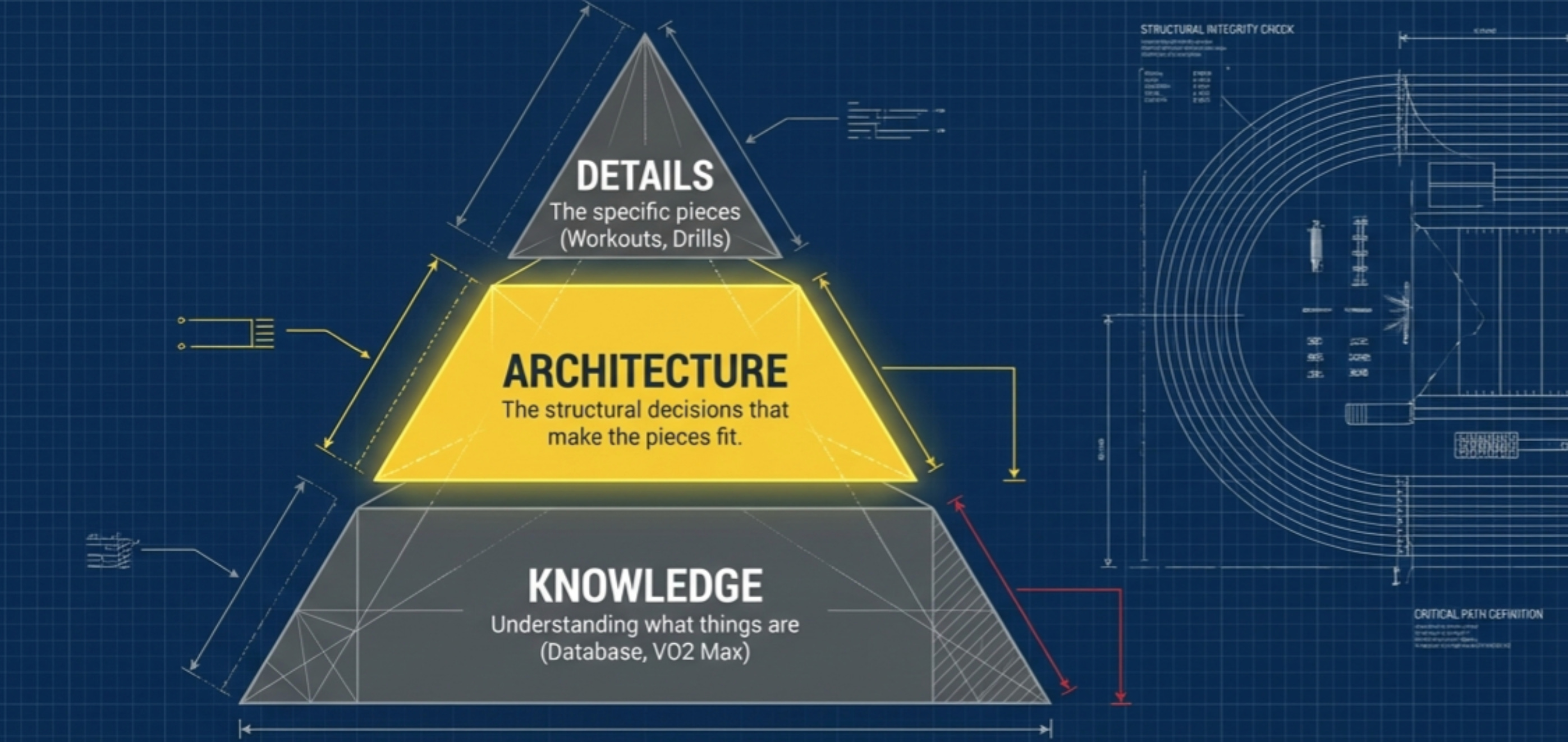
The coaching world has knowledge. It has more details than anyone could use in a lifetime. What it doesn’t have is architecture.
* * *
What I Started to See
Once I had this lens, I started seeing a pattern everywhere.
The programs that won consistently weren’t just running better workouts. They had structure underneath. The coach might not call it architecture. They might not even be able to name what they were doing. But when you looked closely, it was there. Every component of their program served a clear purpose. Every decision had a place to live. The system was coherent, even if the coach built it on instinct rather than intention.
And the programs that struggled? No matter how hard the coach worked, no matter how many clinics they attended, no matter how many plans they copied from the champion down the road? They were missing that layer entirely.
The gap wasn’t effort. It wasn’t talent. It wasn’t even knowledge.
It was structure.
The successful coaches had built architecture, even if they did it unconsciously. The struggling coaches were trying to succeed with details alone. And details alone, no matter how good they are, don’t hold up when things get complicated.
* * *
What Architecture Actually Does
I’m not ready to lay out the full framework yet. That’s coming. But I want to give you a feel for what changes when architecture is present, because it’s not abstract. You feel it every single day at practice.
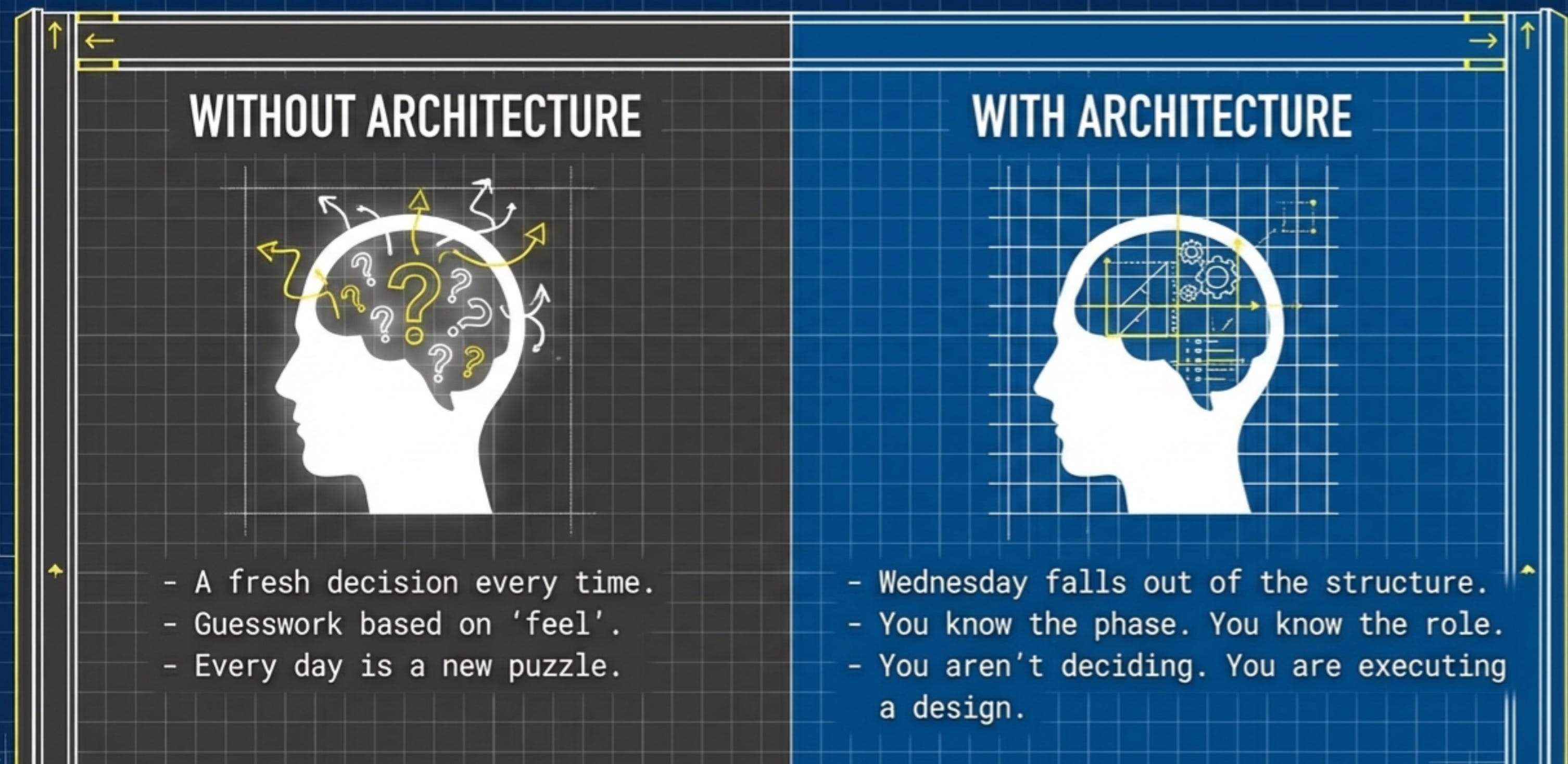
Think about the most common decision you make as a coach: What workout do I run on Wednesday?
Without architecture, that’s a fresh decision every time. You sit down, think about it, weigh options, look at what you did last week, try to remember what phase you’re supposed to be in, and make a call. Tomorrow you do it again. Friday you do it again. Every day is a new puzzle, and you’re the only one who can solve it.
With architecture, Wednesday’s workout falls out of the structure. You know what phase you’re in. You know what that phase emphasizes. You know what role each day plays in the week. The answer is already there. You’re not deciding. You’re executing a design.
That same shift happens everywhere. When an athlete stops improving, architecture tells you which layer the problem lives in instead of leaving you to guess. When reality changes mid-season and the plan stops working, architecture lets you adapt the details without scrapping the whole system. The season evolves instead of collapsing.
It’s the difference between carrying everything on your back and having a structure that carries weight for you.
* * *
Why This Matters
I said in my last article that good coaches are leaving the profession. That they’re burning out. That they’re drowning.
This is why.
They’re drowning because they’re making every decision from scratch. They’re burning out because the entire operation runs on their daily energy. They’re leaving because nobody ever showed them there was another way to build a program.
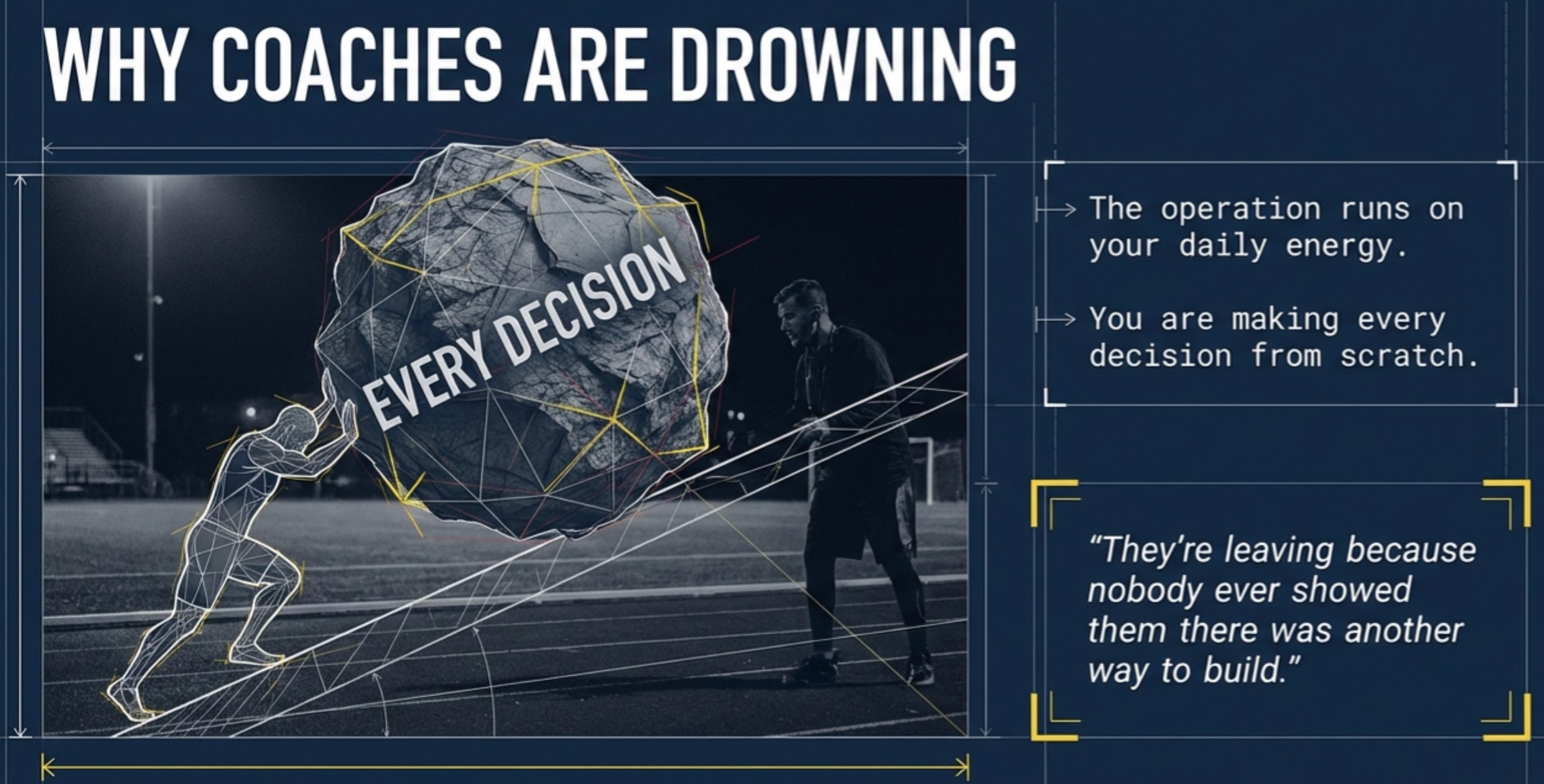
What they need isn’t more knowledge. It isn’t more workouts. It’s structure. A way to organize everything they already know into a system that doesn’t depend on them being “on” every single day.
Architecture doesn’t replace the coach. It just means the coach isn’t doing everything alone anymore. The system starts carrying some of the weight.
And it has to be yours. Just like you can’t copy someone else’s coaching identity, you can’t install someone else’s architecture and expect it to work. It has to be built on your convictions, designed for your athletes, aimed at your goal.
That’s why copying the champion’s training plan never works. You’re not copying their architecture. You’re copying their details. And details without architecture is just activity.
* * *
Architecture is why some coaches get better every year while others just get older. It’s why some programs survive a coaching change and others collapse the day the coach leaves.
It’s the layer that nobody in coaching education is teaching. And most coaches don’t even know it’s missing. They just know something isn’t working, and they can’t figure out what.
I couldn’t either. Not for a long time. Those milk crates can tell you that.
Next week: What does a training architecture actually look like? I’ll show you the shape of the framework I’ve been building for eighteen years.